The challenge
One website, many reasons to visit.
People come to SwornHero with different goals. The challenge was organizing a growing body of projects, documentation, and writing so each visitor finds a clear path to what they came for, without the content getting in each other’s way.
Learn about the developer
Some visitors want to know who is behind the projects and what experience they bring to Minecraft development and server administration.
Explore individual projects
Others arrive looking for a specific mod or technical project and need to understand what it is and where it stands.
Find practical guidance
People already using a project need installation, configuration, and troubleshooting help they can find without asking.
Read the thinking behind the work
Some readers are interested in development decisions and what I am learning along the way, not just the finished result.
Get to repositories and releases
Visitors ready to download or dig into the code need clear links to the relevant project repositories and release pages.
The solution
A portfolio, wiki, and devlog under one roof.
Instead of spreading my work across separate sites, I built one website where project pages, documentation, and writing share the same structure and link naturally to one another.
Personal portfolio and brand
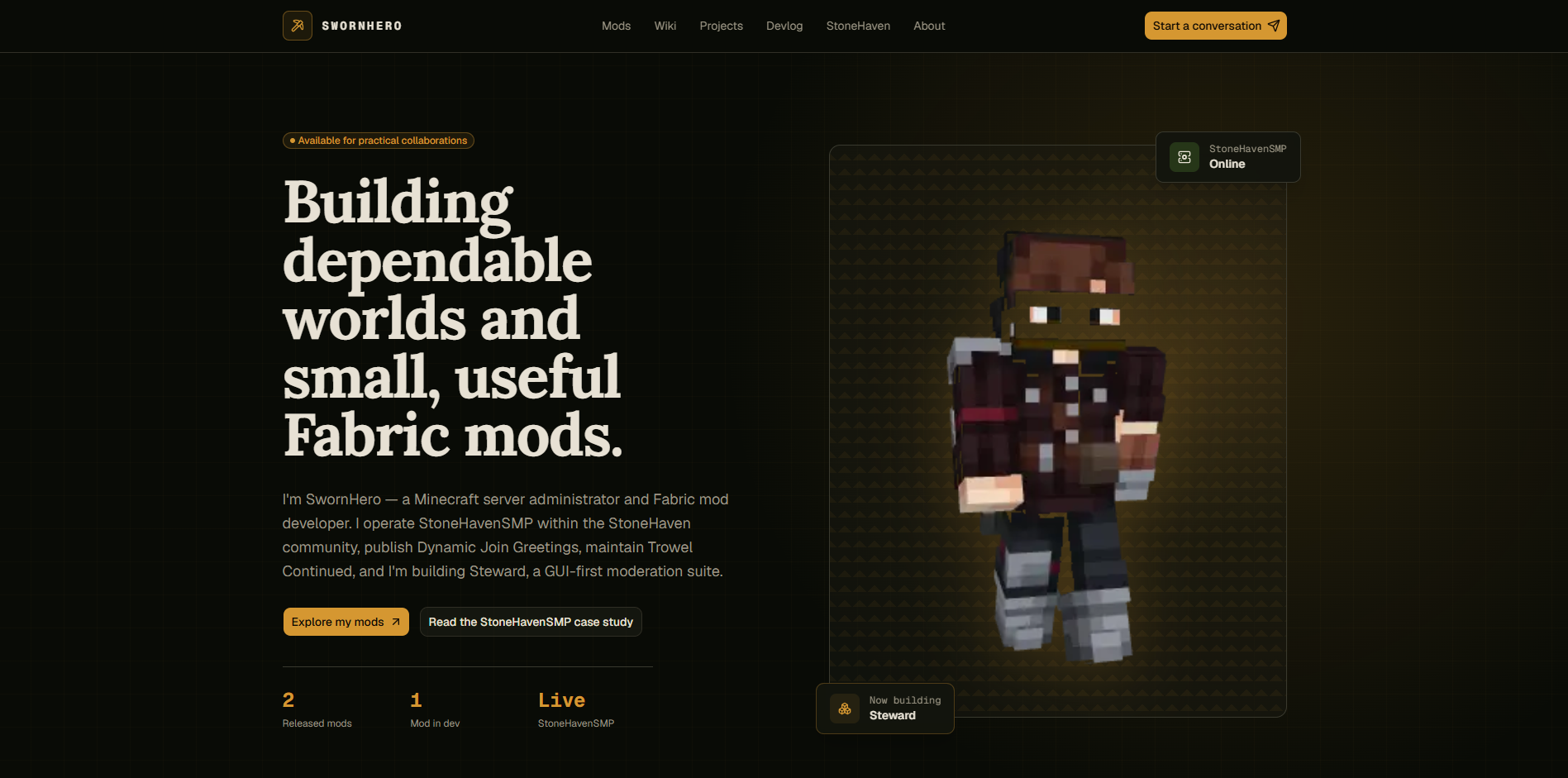
A homepage and supporting pages that introduce SwornHero and the work behind the projects, with a distinct visual identity of its own.
- A homepage introducing SwornHero, plus dedicated About and Projects pages
- Consistent project cards, status labels, and technology tags
- Responsive layouts built from reusable interface components
- Branded typography, imagery, and motion effects
Dedicated mod showcase pages
Individual pages for the Minecraft mods the website presents, each organizing what the project is, where it stands, and where to go next.
- Pages for Dynamic Join Greetings, Trowel Continued, and Steward
- Project descriptions and status in a consistent layout
- Clear next steps, including outbound links to project repositories and releases
Integrated searchable documentation
A wiki built into the same website, so finding a project and learning how to use it happen in one place.
- A Fumadocs-powered wiki served under /wiki
- MDX documentation with structured navigation and tables of contents
- A server-side documentation search endpoint
- Reusable components for project details, compatibility badges, download links, and code examples
- Centralized project configuration shared across documentation components
Development writing
An MDX-powered devlog that connects finished projects with the development thinking behind them.
- A devlog index and individual article pages
- Structured metadata for title, description, date, category, image, and a reading-time label
- Posts sorted by date, with the latest articles selected automatically for the homepage
- Reusable article styling and generated page metadata
Long-form project storytelling
A dedicated StoneHaven server-operations case study on swornhero.com, written for readers who want the full story.
- Section navigation with active-section tracking
- Separate desktop and mobile navigation treatments
The mods themselves are separate projects the website showcases; their in-game functionality is not part of the website. The site’s own look, with its typography, imagery, and motion, belongs to the SwornHero brand.
Technical highlights
The structure behind the content.
Four implementation choices that keep a growing website consistent and practical to maintain.
Reusable content architecture
Repeated information stays consistent across the site, because it is defined once and reused everywhere it appears.
Shared React components handle recurring patterns like project cards, status labels, and technology tags. Centralized project data feeds those components, so a project’s name, status, or links only need to be updated in one place.
Integrated documentation
Discovering a project and learning how to use it happen on the same website, with search across the documentation.
The wiki is built with Fumadocs and MDX, a format that combines Markdown with reusable interface components. Documentation components draw on the same centralized project configuration, keeping details like compatibility and download links consistent. The most complete documentation currently covers Dynamic Join Greetings:
- Installation and updating
- Commands
- Configuration
- Message formatting and placeholders
- Compatibility and troubleshooting
- Developer integration guidance
- Changelog information
Trowel Continued and Steward are already part of the wiki’s project registry, ready for their full documentation to be enabled.
Structured publishing
Every documentation page and devlog article follows the same shape, so new content is quick to add and consistent to read.
Content schemas and generated routes turn MDX files into documentation and devlog pages. Devlog metadata is validated through a Zod schema, which catches missing or malformed fields like a title, date, or category before they reach the page.
Pages also get generated titles and descriptions for search engines and link previews. Content lives as files in the repository rather than in a database or browser-based editor, so every change is versioned alongside the code.
Maintenance tooling
Tooling in the repository supports keeping the code and documentation in good shape as the site grows.
The repository includes linting, TypeScript checking, and a script that checks links between internal wiki pages, so broken references between documentation pages are easier to catch as content changes.
Outcome
A single home for project discovery, technical guidance, and development writing.
Visitors can learn about my work, explore individual projects, find the documentation to use them, and read about how they were built, all on one consistent website that can keep growing with new projects.
Technology
Built with
- Application
- Next.js 16 App Router, React 19, TypeScript
- Interface
- Tailwind CSS 4, shadcn / Base UI, Motion, Lucide icons
- Content and documentation
- Fumadocs, Fumadocs MDX, Zod
- Workflow and analytics
- GitHub, pnpm, Vercel Analytics
What this demonstrates
The same skills, applied to your project.
SwornHero is my own project, but it shows I can organize a substantial amount of content into one cohesive website. These are the kinds of sites I can build for you.